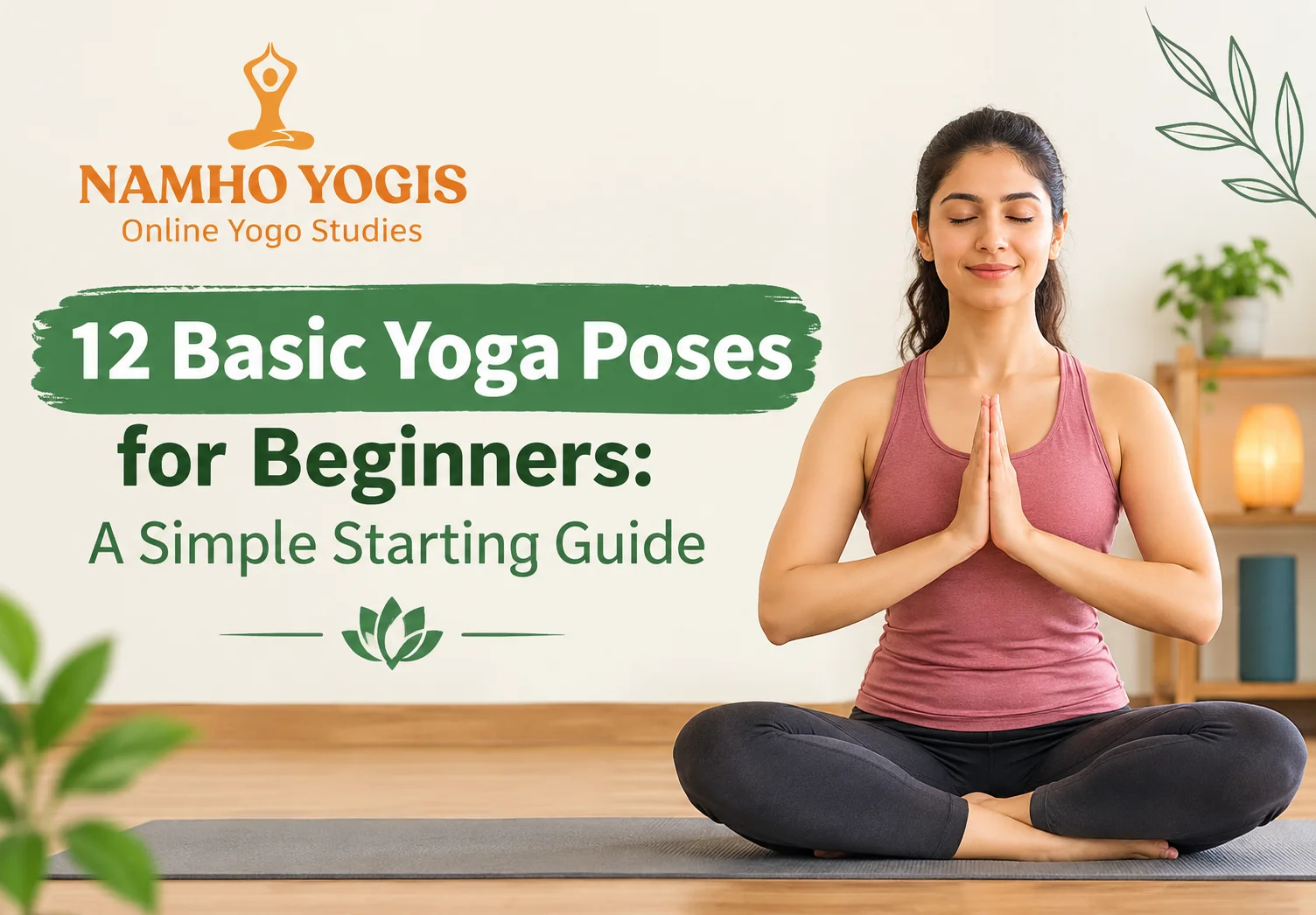
Yoga doesn't actually require fifty poses to get started — it requires about a dozen, done consistently, with reasonably good form. Everything else builds on these basics. Here are the 12 basic yoga poses for beginners that cover almost every foundational movement pattern: standing, forward folding, backbending, twisting, and balance.
1. Mountain Pose (Tadasana)
Stand with feet hip-width apart, weight even across both feet, arms relaxed at your sides. It looks like just standing, but it's really about learning to feel a neutral, balanced posture — the starting and ending point for most other poses.
2. Child's Pose (Balasana)
Kneel, sit back toward your heels, and fold forward with arms extended or resting alongside your body. This is your reset button — use it any time a class feels like too much, no explanation needed.
3. Cat-Cow (Marjaryasana-Bitilasana)
On hands and knees, alternate between arching your back (cow) and rounding it (cat), moving with your breath. This is one of the gentlest ways to loosen a stiff spine, especially first thing in the morning.
4. Downward-Facing Dog (Adho Mukha Svanasana)
From hands and knees, lift your hips up and back, forming an inverted V shape. It stretches the whole back line of the body — calves, hamstrings, spine — and shows up constantly once you start taking more classes.
5. Standing Forward Bend (Uttanasana)
From standing, hinge at the hips and fold forward, letting your head hang. Bent knees are completely fine here, especially early on — this isn't about touching your toes, it's about releasing the lower back and hamstrings.
6. Warrior I (Virabhadrasana I)
Step one foot back, bend the front knee, and raise both arms overhead. This builds leg strength and stability while opening the hips — a good introduction to standing poses that hold for a few breaths.
7. Warrior II (Virabhadrasana II)
From Warrior I, open your hips and arms to the side, gazing over your front hand. It looks similar to Warrior I but works differently — more about stamina and steady focus than depth.
8. Tree Pose (Vrksasana)
Standing on one leg, place the sole of your other foot against your calf or inner thigh (never directly on the knee), hands together at your chest. Balance poses like this build the kind of stability that carries over into everyday movement.
9. Triangle Pose (Trikonasana)
Feet wide apart, reach one hand down toward your shin or the floor while the other reaches up. It's a full-body stretch — hips, hamstrings, spine — and a good introduction to how yoga uses the whole body, not just isolated stretches.
10. Cobra Pose (Bhujangasana)
Lying on your stomach, press your palms down and lift your chest, keeping your elbows slightly bent. A gentle backbend that strengthens the lower back rather than straining it, as long as you don't push into a full extension too early.
11. Bridge Pose (Setu Bandhasana)
Lying on your back, knees bent, lift your hips toward the ceiling. This activates the glutes and core while opening the front of the hips — genuinely useful if you sit most of the day.
12. Corpse Pose (Savasana)
Lie flat on your back, arms and legs relaxed, and do nothing at all for a few minutes. It looks like the easiest pose in yoga and is often the hardest, since it asks you to actually be still. Every class should end here.
How Often Should You Practice These?
Twelve poses is plenty to build a real beginner routine — you don't need to add more before you've gotten comfortable with these. Two to three sessions a week is a realistic starting frequency: enough to build familiarity and a bit of strength without so much that soreness or burnout gets in the way. Daily practice isn't necessary at this stage, and honestly tends to backfire for total beginners, since new movement patterns create their own soreness that needs a rest day to settle.
What matters more than frequency is getting actual feedback on your form early on — a subtle mistake in Downward Dog or Warrior II, repeated three times a week for a month, can turn into a habit that's harder to unlearn later than it would've been to fix on day one.
A Better Way to Learn These Than a List
Reading through 12 poses is a fine starting point, but yoga is a physical skill, and physical skills are learned faster with feedback than with a description. Namho Yogis' Small Group Live Yoga Classes walk beginners through exactly these kinds of foundational poses, live, with an instructor watching your form and correcting it before a habit sets in — scheduled across EST, CST, and PST so there's a slot that actually fits your week.